No-drill grab bars are tempting. They're cheap, they go up in a minute, and you don't need to ask a landlord or own a drill. But a grab bar has one job: hold you when you start to fall. So the real question isn't "Is it convenient?" It's "Will it hold when it matters?" Here's what research and public-health guidance say about each type.
The short answer
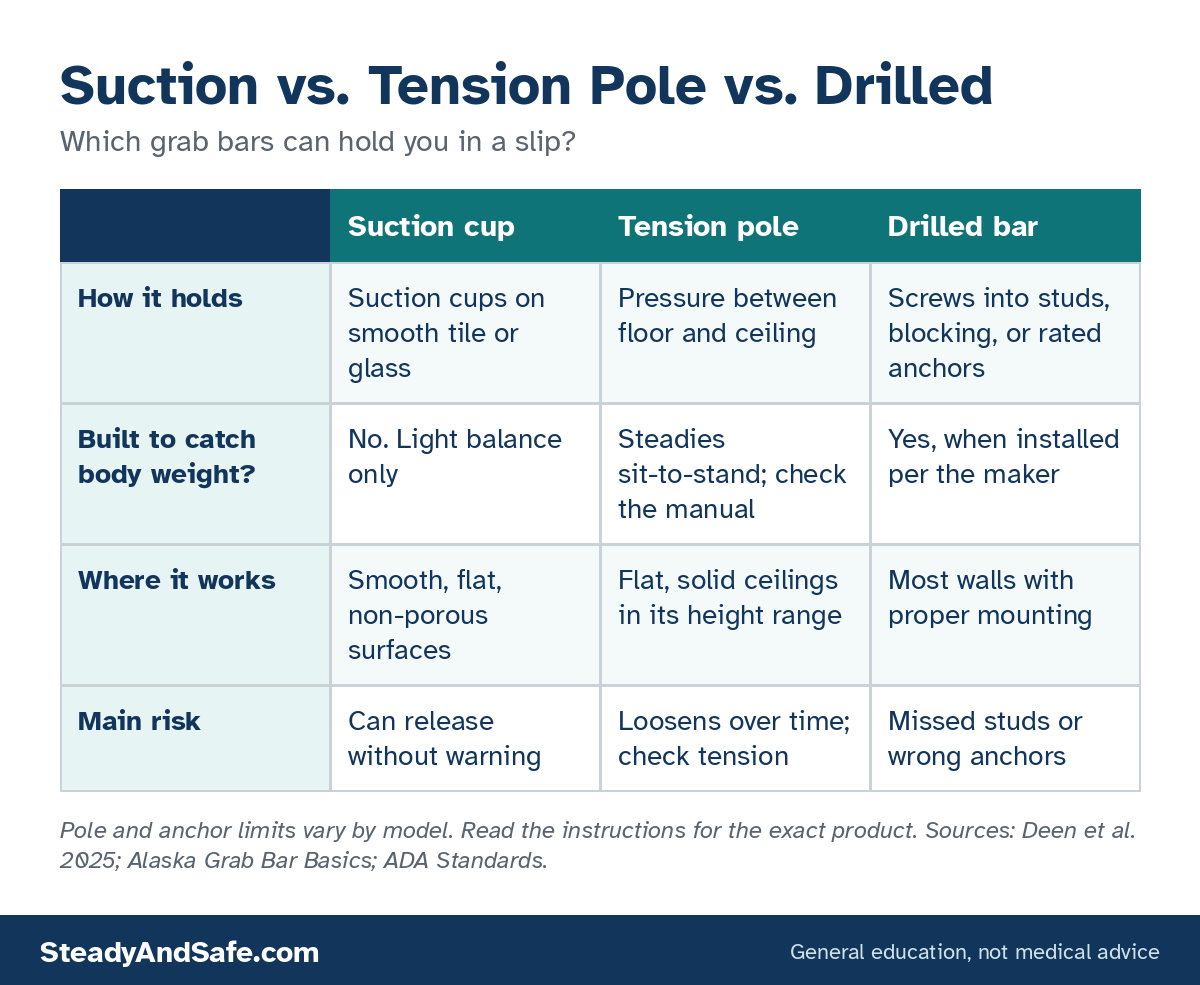
- Drilled grab bars, screwed into wall studs or solid blocking, are the only type designed to take your body weight in a slip.
- Suction-cup bars can release without warning. At most, treat them as a light balance aid, never something to catch yourself on.
- Tension (floor-to-ceiling) poles are a reasonable renter option for sitting and standing, outside the tub or shower, within the maker's limits.
The three types, explained
Suction-cup grab bars
Two large suction cups press onto a smooth, non-porous surface like glazed tile or glass. Many have a color indicator that's supposed to show when the seal is weakening. They're portable and leave no holes.
Tension (floor-to-ceiling) poles
A vertical pole wedges between the floor and ceiling under pressure, usually with a turn-crank. Some add a curved or horizontal handle. They're often placed beside a toilet, bed, or chair.
Drilled (wall-mounted) grab bars
A metal bar is screwed through flanges into wall studs or wood blocking behind the wall, or into the wall with anchors rated for that surface. This is the type you see in accessible public restrooms.
Bonus: clamp-on tub rails
A rail that clamps onto the side wall of a bathtub. It gives you a handhold right where you step in. It's a helpful temporary option, but it depends on a solid tub wall and a tight clamp, and it isn't a substitute for a drilled bar.
What the research says about suction grab bars
A 2025 peer-reviewed laboratory study tested suction-cup handholds on typical bathroom surfaces and wall materials and found low efficacy, meaning they often didn't hold up the way people would need them to.
The State of Alaska's Grab Bar Basics guide is blunter. It warns that suction bars can release randomly, and points out that when someone slips, they grab whatever is closest, with their full weight. A bar that holds most of the time isn't good enough if it fails the one time it's needed.
That's also why a suction bar's indicator is only partly reassuring. Heat, humidity, grout lines, and textured tile can all weaken the seal between checks.
My take: I don't recommend suction bars as your main support. If you already have one, use it only for light balance, check the seal before every use, and plan for a drilled bar.
Tension poles: helpful, with limits
Tension poles can be a good middle ground, especially for renters. But read the manual closely. As one example, the manual for Stander's Security Pole says the pole:
- Fits flat ceilings between about 7 and 10 feet high.
- Should not be installed inside a tub or shower.
- Is meant to steady you while sitting and standing, not to hold your full body weight.
- Has a 300 lb user weight limit.
- Should be checked and retightened regularly.
Other poles have different limits, so check the one you're considering. Popcorn, sloped, or drop ceilings may not hold a pole securely.
Drilled grab bars: done right
A drilled bar is only as strong as what it's screwed into. A few basics:
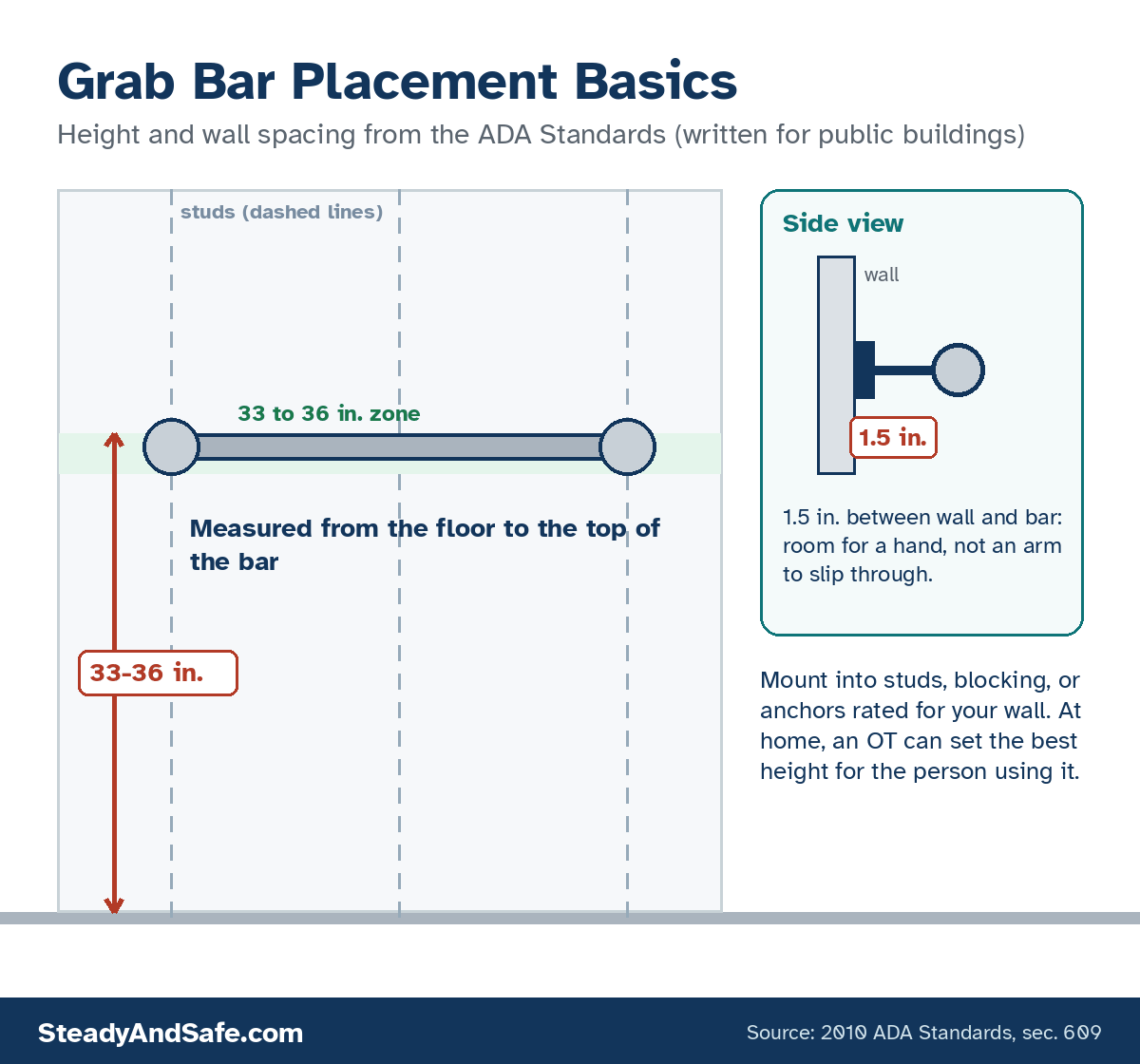
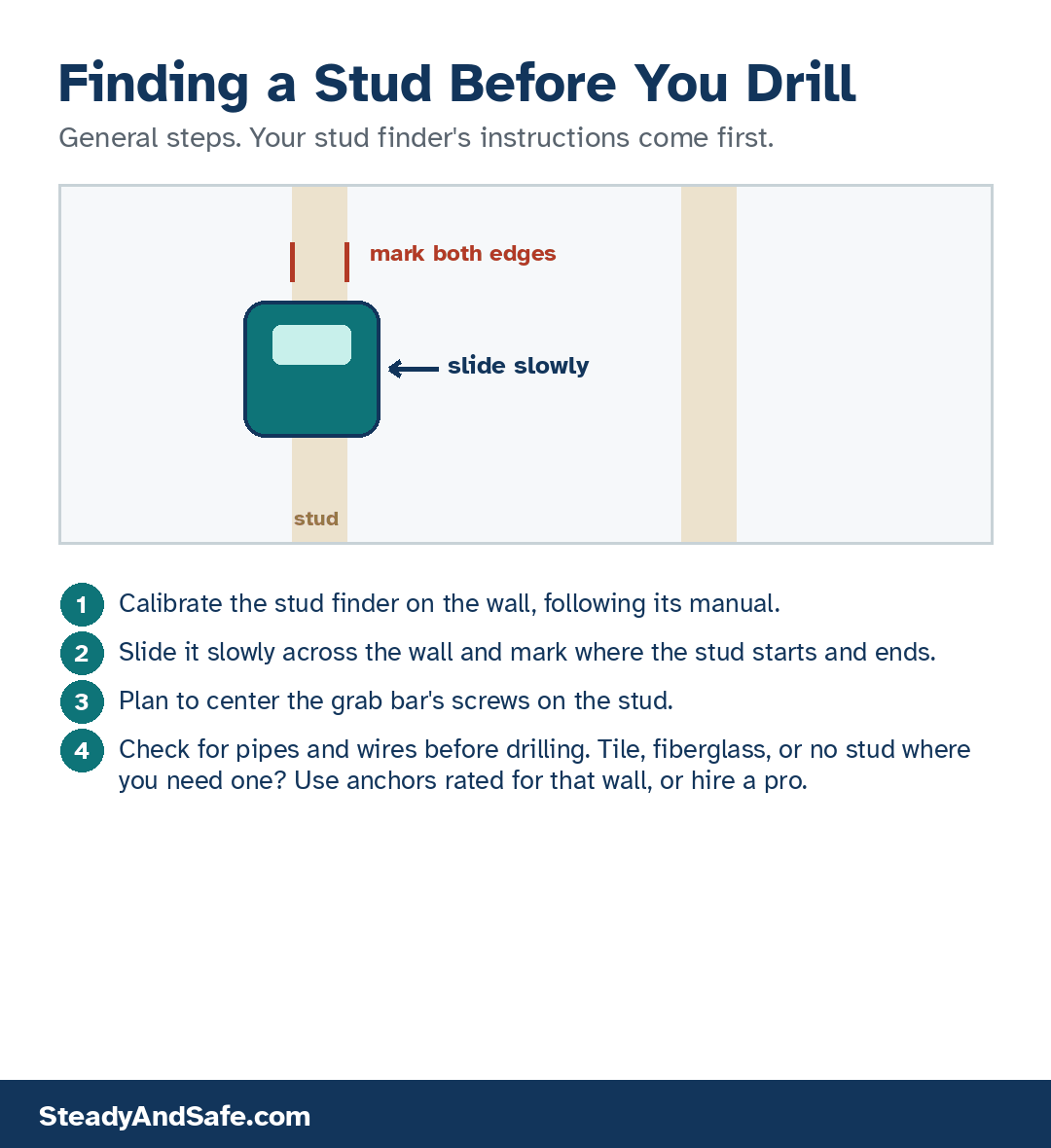
- Mount into studs or solid blocking. Drywall alone won't hold a fall. Use a stud finder, or have blocking added during a remodel.
- Height: for public buildings, the ADA standards place horizontal grab bars 33 to 36 inches above the floor. At home, that's a good starting point, but an OT can help set the best height for the person using it.
- Spacing from the wall: the Alaska guide notes the standard 1.5-inch space between the bar and the wall. That's enough room for your hand but not enough for your arm to slip through.
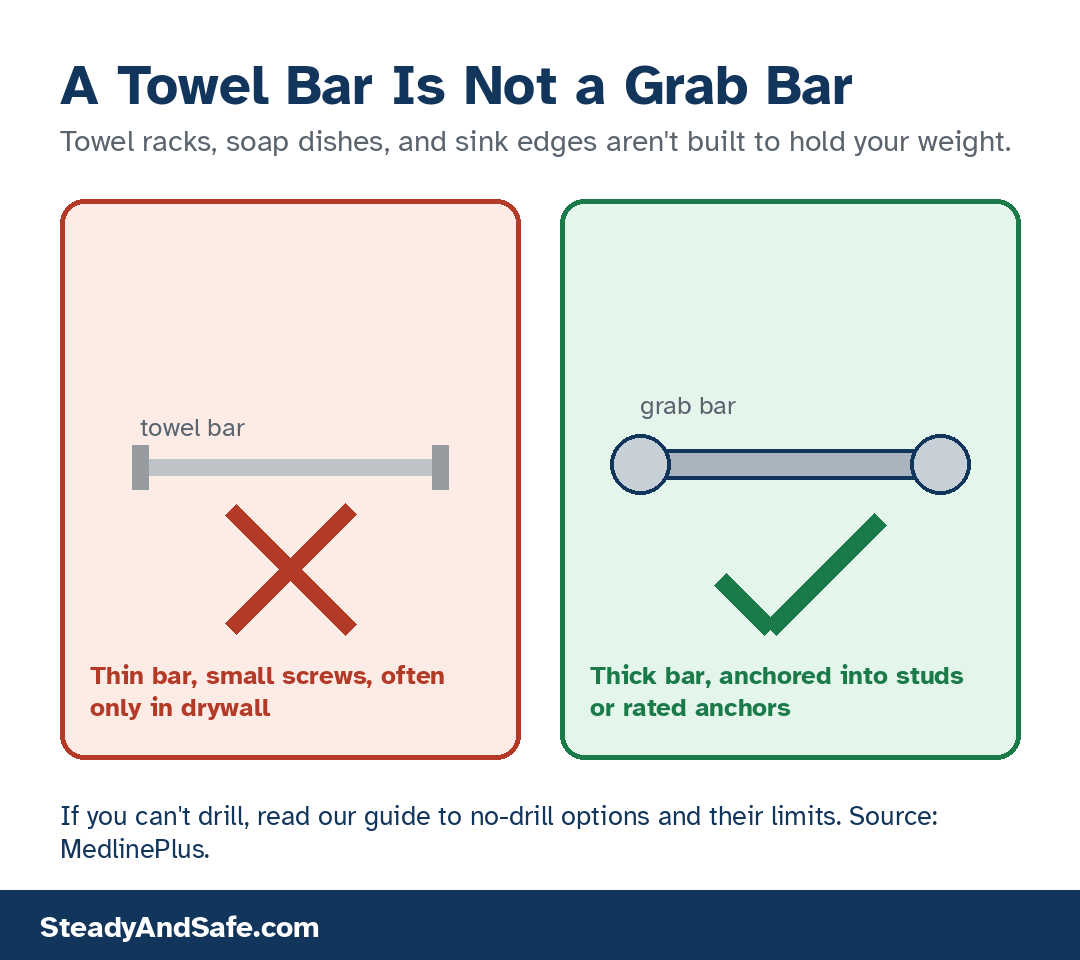
- Towel bars are not grab bars. MedlinePlus warns not to use towel racks, soap dishes, or sink edges as handholds. They aren't built for that load.
- Fiberglass and acrylic surrounds often have an air gap behind them, according to the Alaska guide. Use anchors made for that situation, or hire a pro.
Where to put them
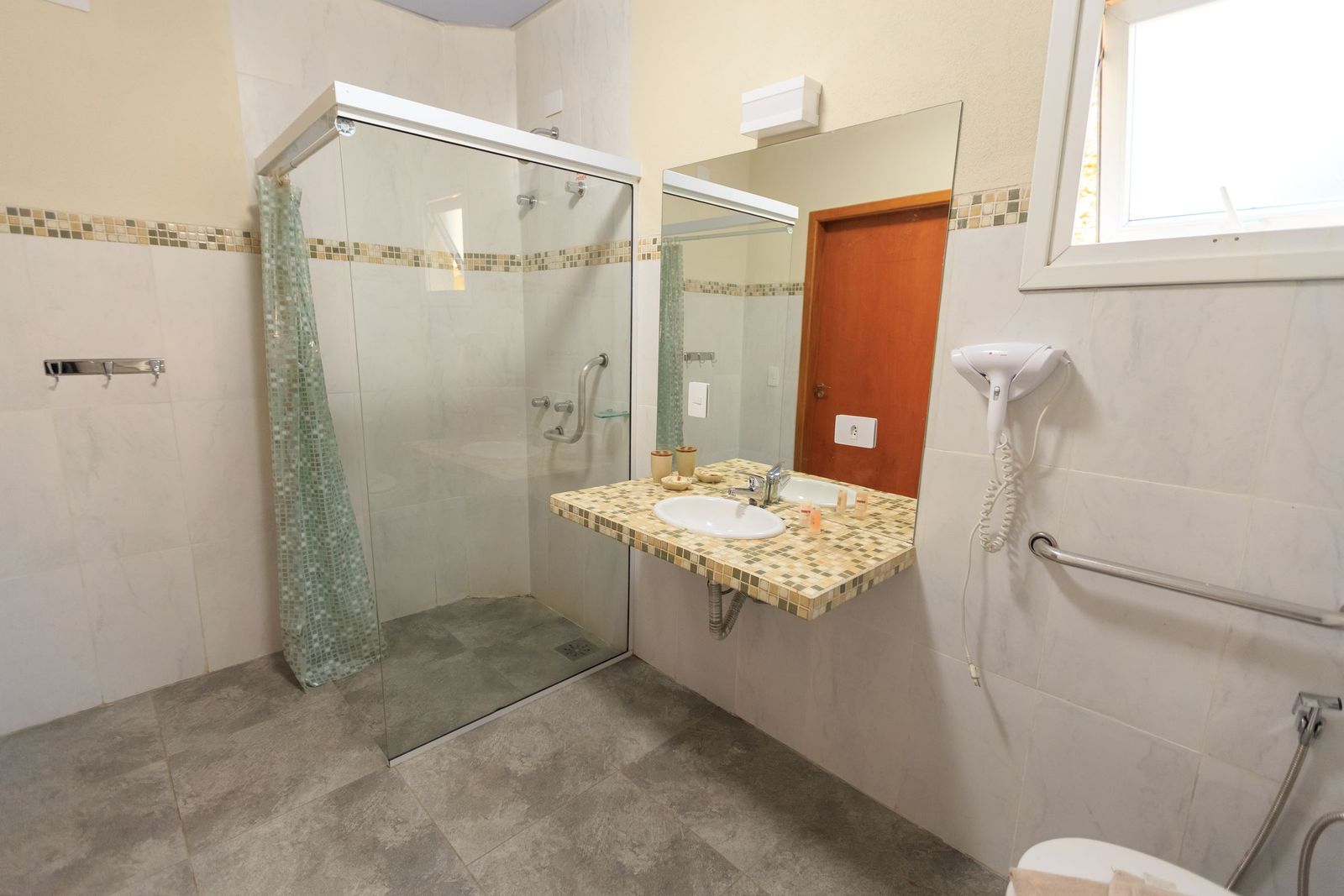
The National Institute on Aging recommends mounting grab bars near toilets and on both the inside and outside of your tub and shower. The CDC's Check for Safety checklist also suggests grab bars inside the tub and next to the toilet.
Renting? Your options
- Ask your landlord in writing. Many will allow a drilled bar, especially if you offer to have it installed professionally and patch the holes when you move. If you have a disability, you may have rights to reasonable modifications under fair housing rules; check with your local fair housing office.
- Use a tension pole beside the toilet or the tub (not inside it), within the maker's limits.
- Add a clamp-on tub rail for help stepping in and out, and check the clamp regularly.
- Sit to shower. A shower chair or tub transfer bench reduces how much you depend on a handhold at all. See Shower Chair vs. Tub Transfer Bench.
- Make the toilet easier. A toilet safety frame gives you armrests without drilling. See Raised Toilet Seat vs. Toilet Safety Frame.
Products to consider
These picks come from each maker's published specs and installation guides. I haven't installed or used these grab bars myself, so these aren't hands-on reviews. Read the instructions for the exact model before you install anything, and confirm the weight rating on the product page.
Drilled grab bars
Moen Home Care 24-inch Concealed Screw Grab Bar (L8724).
- Pros: Moen lists a 500 lb weight rating; 1.25-inch diameter, which is easy to grip; designed to meet ADA guidelines; Moen's SecureMount design is made to let you hit a stud at any angle; limited lifetime warranty.
- Cons: still has to be screwed into studs or into anchors rated for your wall; the bar itself has no added grip texture, so if wet hands are a worry, compare it with the LiveWell bar below.
LiveWell 32-inch ADA-Compliant Grab Bar with Grips.
- Pros: 304 stainless steel; rubber grip sections for a better hold with wet hands; 1.25-inch diameter; comes in lengths from 16 to 48 inches, so you can match your stud spacing.
- Cons: like any drilled bar, it needs solid mounting; longer lengths need more wall space.
Anchors for walls without a stud where you need one
Moen SecureMount Anchors (SMA1000). Anchors designed for mounting grab bars where there's no stud.
- Pros: Moen's spec sheet lists a 300 lb user weight limit and covers drywall (including drywall behind tile or marble) and fiberglass surrounds within listed thicknesses.
- Cons: needs a 1.25-inch hole and at least 3.5 inches of clear space behind the wall; lower rating than a bar mounted into studs; read the spec sheet's wall-thickness limits before you buy.
Floor-to-ceiling tension poles
Stander Wonder Pole.
- Pros: no drilling; fits ceilings from 7 feet to 9 feet 6 inches; a pivoting handle that locks every 45 degrees, so you can set it where you push up.
- Cons: needs a flat, solid ceiling; must be checked and retightened as the maker directs; check the manual for where it may and may not be installed.
Stander Double Handle Floor to Ceiling Grab Bar. A pole with two handles for sit-to-stand help.
- Pros: no drilling; two handholds at different heights.
- Cons: same ceiling and retightening limits as any tension pole; confirm the height range and weight limit in the manual before you buy.
Clamp-on tub rails
Drive Medical Clamp-On Tub Rail (fits tub walls 3 to 7 inches wide; 300 lb listed capacity) and Carex Bathtub Rail with Chrome Finish (fits walls about 3.5 to 6 inches; 200 lb listed capacity). Both give a handhold where you step in. Neither replaces a grab bar in the wall.
Not recommended as a main support
Suction-cup grab bars. For the reasons above, I don't recommend any suction bar for holding your weight.
The bottom line
If a grab bar might ever catch your full weight, it should be drilled into studs or blocking. Suction bars are a convenience, not a safety device. Tension poles and tub rails can bridge the gap for renters. And if you aren't sure what's behind your wall, a licensed handyman or an OT home visit is money well spent. Next, check the floor: my guide to non-slip bath mats and tub strips covers the other half of bathroom safety, and the room-by-room home safety checklist covers the rest of the house.
Questions people ask
Are suction grab bars safe for seniors?
Not as a main support. A 2025 lab study found low efficacy for suction handholds, and Alaska's grab bar guide warns they can release without warning.
Do suction grab bars work on tile or fiberglass?
They need a smooth, non-porous, flat surface. Grout lines, textured tile, and some fiberglass finishes can keep them from sealing well. Even on good surfaces, the seal can weaken.
Are suction grab bars ADA approved?
The ADA standards cover grab bars in public buildings and set structural strength requirements, which is why those bars are mounted to the wall's structure. Suction bars aren't a substitute.
How do no-drill grab bars work?
Suction bars stick with suction cups. Tension poles press between the floor and ceiling. Clamp-on rails grip the tub wall. None of them is anchored into the wall's framing.
How do you install a grab bar without drilling?
Your realistic options are a tension pole (outside the tub), a clamp-on tub rail, or a suction bar for light balance only. For full support, a drilled bar is the safe choice.
Is a suction bar OK if I'm careful?
Being careful helps, but falls happen fast and you can't control what you grab. If a suction bar is all you have for now, use it only for light balance and check it every time.
Read next
Sources
- Deen et al., 2025
- Alaska Grab Bar Basics
- Stander Security Pole manual
- ADA Standards ch. 6
- MedlinePlus bathroom safety
- NIA room by room
- CDC Check for Safety
- CDC older adult falls
- Moen SecureMount anchor spec sheet
Product details come from each maker's product page, checked October 2026.